


Power constraints have been widely discussed as data centers and AI infrastructure investments have accelerated, but the issue extends beyond data centers. Semiconductor plants, factories, and broader economic growth are also pushing electricity demand higher after nearly 20 years of stagnation—while much of the supporting infrastructure is decades old.
Annual power demand growth is expected to accelerate significantly in the coming decades. Projections from the U.S. Energy Information Administration (EIA) show a 1.3 percent annual growth rate through 2050, more than double the 0.6 percent rate seen over the past 20 years. The EIA expects this dynamic to lift total consumption past 6,000 terawatt-hours, about 45 percent above current levels, while more aggressive growth scenarios forecast up to 6,350 terawatt-hours.
Power demand expected to accelerate
Total U.S. electricity consumption, all sectors (terawatt-hours)
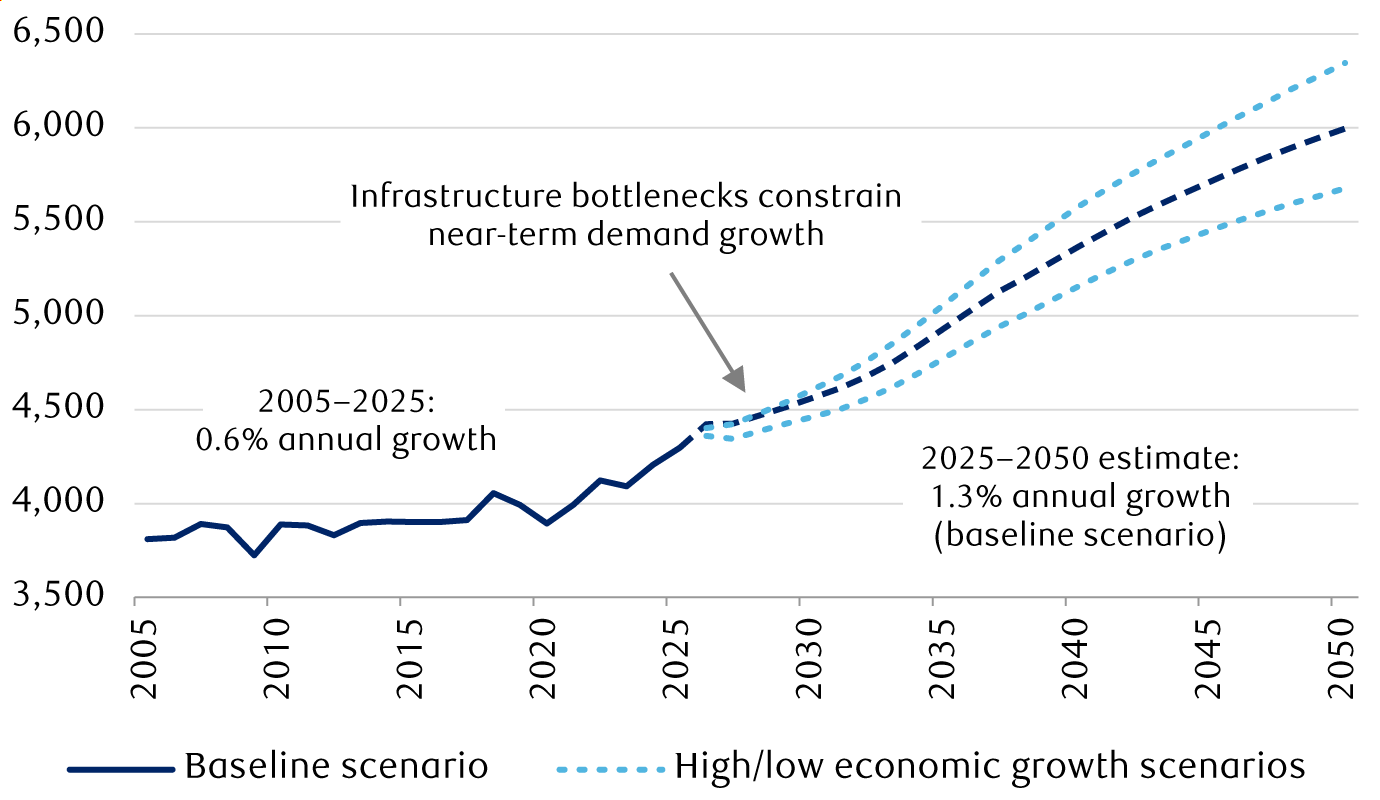
Source - RBC Wealth Management; U.S. Energy Information Administration Annual Energy Outlook 2026
Meanwhile, more than 70 percent of U.S. transmission lines and large power transformers are over 25 years old, according to the U.S. Department of Energy (DOE). The issue isn’t that the U.S. is running out of power, but that infrastructure cannot be built quickly enough to meet new demand. Transmission backlogs, equipment shortages, and slow regulatory approvals have created major physical bottlenecks that we think will likely take years to clear.
The economic impact
That timing mismatch is increasingly shaping where and how companies invest. If a firm has the capital and technology to build but cannot secure power for several years, the grid can become a constraint on economic growth.
A recent development out of Oracle represents a timely example. Just last week, the company issued a “force majeure” notice related to Project Jupiter, a massive $165 billion, 2.5-gigawatt data center project in New Mexico being developed to support OpenAI. The notice was tied to potential delays in securing power for the project and would allow Oracle to defer lease payments if the facility misses its planned 2028 completion date. The project has also faced delays related to a natural gas pipeline intended to supply its on-site power and a pending air-quality permit for the fuel-cell system.
We don’t believe these types of issues are unique to Oracle. The company seemingly has the capital, customer demand, and technology to get the data center built, yet power infrastructure and permitting are still constraints on when that capacity can come online. That is exactly the type of timing gap we expect to become more common as data center construction accelerates.
This matters because significant public and private resources have been committed to expanding domestic AI infrastructure, semiconductor fabrication, and manufacturing. These strategic investments are meant to drive economic growth and productivity, but their ultimate impact remains constrained by the capacity of the power grid.
That is why we view the power buildout as more than just an energy or utility sector story. The ability to generate and deliver power is increasingly tied to the country’s ability to grow and compete, meaning the grid can no longer be treated as an afterthought.
A more supportive regulatory environment
The required investment is substantial, but, encouragingly, policymakers and regulators are increasingly clearing the way for it.
At the Federal Energy Regulatory Commission, the federal regulator overseeing the grid, recent reforms are aimed at addressing some of these bottlenecks. The focus is on encouraging utilities to plan further ahead, improving the process for connecting new projects, and making it easier to allocate costs across regions. The DOE is also directing billions of dollars toward transmission expansion and supporting domestic manufacturing of critical equipment such as large transformers. The Trump administration has also used the Defense Production Act to designate grid infrastructure and related supply chains as critical to national defense, opening the door to additional support, such as financial aid and streamlined approvals, for domestic production of transformers, transmission equipment, and other grid components. We think, taken together, these efforts show that policymakers and regulators are increasingly focused on strengthening the grid, which we believe should support investment over the long term.
While these changes don’t remove physical constraints, they improve project visibility and economics, making it easier for companies to commit capital.
Investing in electricity
Given this backdrop, we see three major areas of opportunity across the power system, each tied to a specific bottleneck: generation, electrical equipment, and grid infrastructure.
Generation is the most direct requirement. The U.S. needs more reliable capacity as power demand rises, particularly from data centers and industrial facilities. Natural gas should remain important because of its ability to provide reliable, dispatchable power, while existing nuclear generation is becoming increasingly valuable as demand for carbon-free electricity grows. Over time, additional generation capacity across multiple technologies will be needed to meet the scale and reliability requirements of a more power-intensive economy.
The second opportunity is the electrical equipment needed to connect that generation to new demand. Transformers, switchgear, circuit breakers, and other components are essential for new construction and the replacement of aging infrastructure, but supply has struggled to keep pace. Long lead times and growing backlogs highlight the importance of expanding manufacturing capacity while also upgrading the existing equipment base.
The third opportunity is the grid itself. Generation only has value if electricity can reach the end user. New transmission lines, substations, and distribution infrastructure will be needed to serve large industrial loads and connect new generation. Grid modernization also has a durable component, since much of the existing infrastructure needs to be upgraded regardless of how quickly AI demand develops.
Where we go from here
The U.S. spent much of the past two decades with little growth in power demand. But we think the next decade, and beyond, will likely look fundamentally different. AI, manufacturing, and broader economic expansion will require substantially more power, straining a grid whose physical limits were set long before this demand emerged.
We believe investors should focus on the industries closest to those limits: the companies providing the generation, the equipment, and the infrastructure to connect new demand.