
But first, let’s assuage some likely fears. The economy has weathered higher interest rates exceptionally well for years now, and one 25 basis point rate hike from the Fed is unlikely to change that fact. To wit, the fact that the U.S. economy has weathered rates so well is largely the reason we believe the Fed chose to raise rates this week.
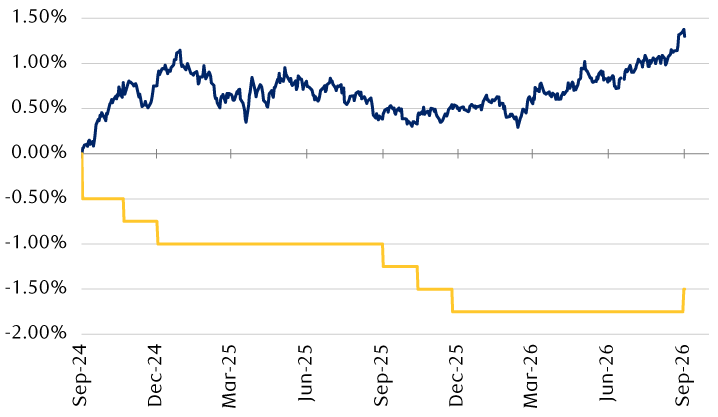
At no point since the Fed started cutting short-term interest rates in 2024 has the benchmark 10-year Treasury yield—which is the real basis for most business and consumer borrowing rates—traded lower than it had been back then. As the Fed cut overnight rates down to what is now 4.00 percent from 5.50 percent, the 10-year Treasury yield rose from about 3.65 percent and ultimately breached the five percent level this week—marking a fresh trading high since 2007 in the process.
Treasury yields have only moved higher despite Fed rate cuts
Changes in the federal funds rate and 10-year Treasury yield since September 2024
Source - RBC Wealth Management, Bloomberg
The line chart shows the percentage change in the benchmark U.S. 10-year Treasury yield and the federal funds rate since the Federal Reserve began cutting policy rates in September 2024, through September 17, 2026. Over that period, the 10-year yield has risen by 1.3 percent, even as the Fed lowered short-term rates by what is now 1.5 percent following the 0.25 percent rate hike on September 16, 2026.
So, even as key interest rates remained high, economic growth has stayed robust, labor markets have largely maintained “full employment” around 4.2 percent, and inflation has failed to make material further progress toward the two percent goal. All told, most economic and market data has signaled not only that the Fed probably didn’t need to cut rates any further, but rather that policy rates might need to be a bit more restrictive—or as Fed Chair Kevin Warsh put it, they removed a “dose of accommodation.”
In a sense then, any near-term rate hikes from the Fed are effectively just marking-to-market short-term policy rates with longer-term Treasury yields, something which perhaps makes sense for Warsh, who has arguably attempted to outsource Federal Reserve decision making to the markets.
But as many have already opined, a simple 25 basis point rate hike doesn’t really do much, so what might the Fed have to do then, and in pursuit of what exactly?
Rate cut take back
The Fed delivered three 25 basis point rate cuts toward the end of 2025 as signs of a weakening labor market spurred policymakers into action. But those rate cuts—which act with a lag on the economy—are now showing up in the form of lower unemployment and what Chair Warsh characterized this week as a “strengthening” economy.
Therefore, our base case is that the Fed raises rates at each of the final two meetings of 2026 in October and December, which would bring the policy rate back to a target range of 4.25–4.50 percent.
At that point, the real debate likely begins. We see a prolonged pause as a base case. But if the unemployment rate stays below 4.2 percent, as Fed projections this week indicated, and growth remains strong, as the Fed also expects, paired with the fact that the Fed still doesn’t expect inflation to reach the two percent target until 2029, then it seems to us entirely possible that the Fed keeps pressing with further hikes in 2027.
The 2-year Treasury yield, which serves as a proxy for market expectations for the path of the Fed’s policy rate, remains near 4.70 percent—that’s higher than any single interest rate forecast submitted by Fed policymakers this week throughout the forecast horizon, which stretches into 2029. Even as policymakers signaled more rate hikes than perhaps analysts were anticipating, markets are saying those projections still aren’t high enough.
But could the Fed actually unwind all of the rate cuts delivered since 2024, which would bring the policy rate back to a range of 5.25–5.50 percent? The short answer is that we think it’s quite unlikely; the longer answer is that unlikely doesn’t mean that it’s impossible.
Are long-end yields a sign of where short-term rates are going?
One point we have stressed in recent months is that the near-term focus on oil prices, or geopolitics, or tariffs, or whatever is missing the forest for the trees—global government bond yields have been rising steadily and consistently, not just this year, not just since last year, but for over five years now.
The 10- and 30-year sovereign bonds of developed countries, such as the U.S., Canada, the UK, France, Germany, Japan, etc., have set fresh decade—if not multi-decade—highs again this week, and there are few signs that this trend is on the cusp of rolling over.
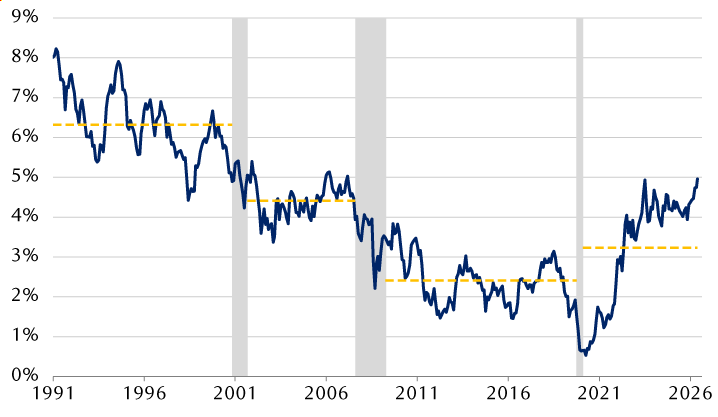
The second chart attempts to frame how we’re thinking about the benchmark 10-year Treasury yield in the United States. At around five percent this week, it’s now at risk of eclipsing the 2007 peak around 5.3 percent.
Benchmarking the benchmark
Tracking the 10-year Treasury yield across past economic eras suggests higher yields may be ahead
Source - RBC Wealth Management, Bloomberg
The line charts shows the benchmark 10-year U.S. Treasury bond yield since 1991 and the average yield level during each of the economic expansions in that timespan. Average expansion-period yields were 6.32% from April 1991 through February 2001, 4.41% from December 2001 through November 2007, 2.41% from July 2009 through January 2020, and 3.23% from May 2020 through September 17, 2026.
Is that high enough to help achieve the Fed’s objective of restraining economic activity to sufficiently bring inflation once and for all back down to two percent? Well, 2007 was all about housing and consumer borrowing. But that’s not where we are today, as the housing market hasn’t really been an economic factor for years now.
What is this current cycle all about? Corporate borrowing and the AI-related infrastructure buildout. Those themes have more parallels to the 1990s than the early 2000s. While consumers are typically more sensitive to interest rates, companies usually aren’t to the same extent, and that is almost certainly even more true for the hyperscalers.
And those hyperscalers have been falling over themselves to issue debt this year with most coupon ranges between five percent and low-six percent. Would seven percent cool that demand? Eight percent? We don’t know, but it feels safe to say that it’s something higher than current levels. And if history is a guide, then maybe we have to look at the 1990s when the government was paying over six percent on 10-year paper, and highly rated companies were paying between six and eight percent.
We’re in an environment where the demand for capital seems limitless, whether it’s government borrowing needs around the world from high deficits or the AI buildout, and that demand for capital should only keep making it more expensive, in our assessment. With the Fed likely to continue taking its cues from markets, markets keep signaling that higher rates could be on the horizon.