

“Soon” isn’t soon enough
RBC Capital Markets, LLC’s Helima Croft, head of global commodity strategy and Middle East and North Africa (MENA) research and long-time Middle East expert going back to her tenure as a Central Intelligence Agency analyst in the post-9/11 era, has been pointing out to institutional investor clients lately that “soon” is the most overused word in the Iran war.
Quite frequently since the war began in late February of this year, and even in the past few days, major media outlets have quoted “unnamed sources” saying that the war could end soon. Some cite a potential diplomatic agreement mediated by Pakistan and Qatar, and others in the “finish the job” camp cite the need for American shock-and-awe kinetic strikes with the hope this could end the conflict.
However, Croft sees no signs of the war ending in the near term. Instead, there are risks the Middle East crisis will intensify and widen.
First, the Trump administration continues to prosecute an expensive blockade on Iranian ports while pressuring Iran’s neighbors to diminish or halt trade with Iran over land routes amid sanctions threats, and the U.S. Navy continues to build up assets in the region. At the same time, top Iranian officials have been crystal clear that if the country is hit hard again militarily, it will strike back at American and other infrastructure assets in the region. It has also signaled it will respond to ongoing financial pressures. In other words, the struggle will drag on.
Second, the conflict between the Saudis and Ansar Allah in Yemen (which includes the Houthis) is escalating militarily rather than deescalating.
While this war is related to the ongoing U.S./Israel-Iran conflict—Croft calls it a “second front” and cites evidence of weapons and financial support supplied by Iran to Ansar Allah—it’s also a very separate dispute with its own history.
The Saudi-Yemen war has been going on for years over territorial and other grievances that have existed for many decades, especially since the 1930s.
Therefore, Ansar Allah functions less like a pure Iranian proxy, as it is often portrayed in the media. It has independent leadership and its own regional objectives.
Just like the Iran war, financial markets seem to be assuming the Saudi-Yemen conflict can be resolved soon. But we don’t believe the main parties are ready to embrace realistic offramps in the near term.
In Croft’s assessment, the longer these two conflicts persist, the longer energy prices will remain elevated, and the greater the economic pain.
And we think prolonged Middle East turmoil increases the risks of a Federal Reserve monetary policy error—perhaps Fed officials don’t hike enough in the face of energy-induced inflation pressure or, conversely, they could end up hiking too much.
Cost of $1,083 per U.S. household and counting
High diesel and gasoline prices have hit Americans’ pocketbooks hard and have strained the finances of many others around the world, whether in developed or emerging economy countries.
Households, truckers, farmers, and more are bearing the brunt of higher fuel prices
American Automobile Association daily national average fuel price data per gallon in U.S. dollars
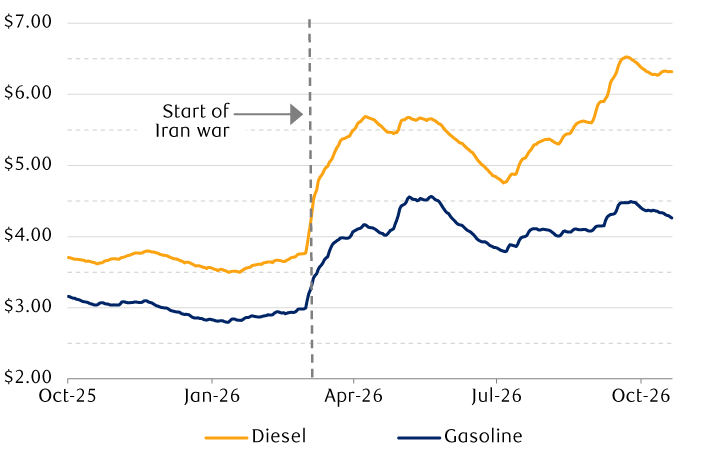
Source - RBC Wealth Management, Bloomberg; gasoline is the regular unleaded grade; data through 10/20/26
The line chart shows the average daily price of diesel fuel and gasoline (petrol) in the U.S. from October 1, 2025 through October 20, 2026. Prices were relatively low (diesel under $4.00; gasoline around $3.00) until February 28, 2026, when they began to rise rapidly at the beginning of the Iran war. On October 1, 2025, diesel cost $3.69 and gasoline cost $3.16. After the start of the war, diesel jumped to above $5.60 per gallon in April 2026, pulled back during the summer, and then rose again to a new high of $6.53 on September 21, 2026. Similarly, gasoline jumped above $4.50 per gallon in May 2026, pulled back during the summer, and then rose again to $4.50 on September 24, 2026. On October 20, 2026, the average prices were $6.32 for diesel and $4.26 for gasoline.
The Watson School of International and Public Affairs at Brown University—one of America’s eight elite Ivy League institutions—estimates the Iran war has cost U.S. households $1,083, on average, so far. Its calculations are based on average fuel prices compared to what would have occurred had the war not started. This cost estimate climbs daily.
Since the Iran war began in late February, the aggregate excess energy cost has been $141.9 billion—$63.6 billion of that for diesel and $78.3 billion for gasoline, The Watson School estimates.
To put this big price tag in perspective, $141.9 billion exceeds the amount that Americans spend on personal care products and services each year.
It’s no wonder the cost of living has become the most important issue for all major American voter groups ahead of the November 3 midterm election, according to multiple polls.
Inflation is the most important issue to Americans
Top issues of concern to adults ranked in order
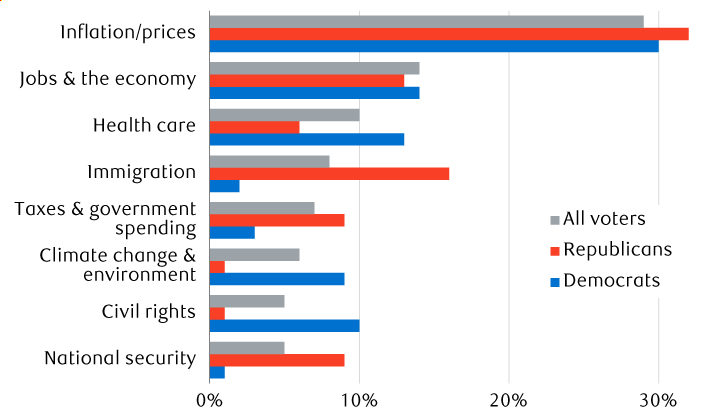
Source - The Economist “Tracking the presidency” results that track YouGov polling; data as of 9/1/26.
The bar chart shows the top eight issues of concern for American adults, with each issue shown for three respondent categories: all voters, Republicans, and Democrats. The issues are ranked in order by the “all voters” category. The issue of greatest concern is inflation: 29% for all voters, 32% for Republicans, and 30% for Democrats. (For other issues, the responses for each of the three categories are listed in the same order.) The second issue of concern is jobs and the economy: 14%, 13%, 14%. Health care is third: 10%, 6%, 13%. Immigration is fourth: 8%, 16%, 2%. Taxes and government spending is fifth: 7%, 9%, 3%. Climate change and environment is sixth: 6%, 1%, 9%. Civil rights is seventh: 5%, 1%, 10%. National security is eighth: 5%, 9%, 1%.
Maintain Energy holdings and be mindful of inflation risks
The potential that these two Middle East conflicts could intensify and expand further across neighboring countries seems underappreciated by financial markets, in our view.
As Croft points out, wars are easy to start but they usually take a long time—sometimes a very long time—to end, especially when coalitions of countries become involved.
When unnamed and named sources have been cited in the press saying that the Middle East hostilities could end soon, we’ve been asked time and time again whether investors should trim or sell Energy stocks.
Each time, we’ve said hang on to them, as the Middle East crisis very likely will drag on and energy prices could remain elevated for longer than U.S. officials would like. This investment advice still rings true today.
Furthermore, we think investors should keep an eye on additional inflation risks associated with the prolongation and expansion of both the U.S./Israel-Iran war and the Saudi-Ansar Allah war.
In terms of equities, this translates into holding no more than Market Weight exposure in portfolios and holding an outsized proportion of defensive stocks, particularly those that consistently grow their dividends year in and year out.